Much of the science at Halley comes from equipment situated in shipping containers that we call cabooses. This one is the Superdarn caboose:
Superdarn is a big radar that looks out over a large part of Antarctica, measuring the position and velocity
of charged particles in the Earth's ionosphere, the highest layer of the Earth's
atmosphere, which tells scientists about the Earth's interaction with the
space environment. Another Caboose we have is the Optical caboose, it contains experiments that look at optical phenomena such as the aurora.
Halley gets a lot of aurora - of course you can only see them in the winter, now its summer with 24 hour daylight and we can't see them - here's a picture of aurora taken at Halley in winter.
You will notice that the optical caboose looks remarkably similar to the Superdarn radar caboose, in fact we have five cabooses that all look very similar - although they are all customised for their particular function. The advantage of running science from cabooses is that they can all be positioned in the ideal place compared to the rest of the stuff around the station. So for instance the optical caboose is over a km from the main station to guarantee that it is very dark, the radars are a km in a different direction so that the large radio pulses they send out don't interfere with the sensitive experiments that are in another caboose over 2 km away in the other direction.
You might be wondering why the cabooses are yellow. Well they are very heavily insulated to minimise energy use in winter when they need to be heated, but in summer when the temperatures are warmer we tend to need to cool the electronics inside, if the cabooses were a dark colour then they would absorb lots of heat from the sunshine and would be difficult to keep cool. Ideally we would paint them white to keep them cool, we tried this once but white cabooses are too hard to see against the snow. This particular shade of yellow doesn't heat up much in the sunshine and is easy to see in both sunny and bad weather conditions.
Inside the cabooses look like a crowded science lab, full of electronics and computers. Here I am inside the optical caboose.
Here is DJ inside a caboose that we call the EMQA caboose - that stands for ElectroMagnetic Quiet Area, it's where we run the sensitive scientific radio receivers from.
And here's Ollie and Neil inside the MFradar caboose - that's another radar - this one measures the wind in the atmosphere from 40km to 100km up.
How many times did you see Penny?
Friday, 3 February 2012
Wednesday, 1 February 2012
Saturday nights, caves and BBQ's
Saturday nights have traditionally been a special night in Antarctica, the chefs make a special meal and everyone else makes a bit more of an effort to be presentable.
On this particular night we had a quiz, our team (ably assisted by Penny) did reasonably well, 3rd out of 10 - we bombed on the sport and celebrity culture. A couple of weeks ago it was a lovely sunny night and with no wind, it felt remarkably warm so we had a BBQ.
Last week it was one of the science team's birthday. Sam, exactly half my age. He has been spending much of his free time hacking out a snow cave and decided to celebrate by squeezing 14 of us in there.
The camera flash doesn't do the colours in the cave justice, so here is one with natural light.
You could just see Penny's nose at the bottom of the last two pictures. And here is Sam, the birthday boy, with Penny.
On this particular night we had a quiz, our team (ably assisted by Penny) did reasonably well, 3rd out of 10 - we bombed on the sport and celebrity culture. A couple of weeks ago it was a lovely sunny night and with no wind, it felt remarkably warm so we had a BBQ.
Last week it was one of the science team's birthday. Sam, exactly half my age. He has been spending much of his free time hacking out a snow cave and decided to celebrate by squeezing 14 of us in there.
You could just see Penny's nose at the bottom of the last two pictures. And here is Sam, the birthday boy, with Penny.
Saturday, 28 January 2012
Halley 6 - first bit
In an earlier post (22nd Dec) on Halley 5, I mentioned the two problems of building on a iceshelf - the constant accumulation (that plagued Halleys 1 to 4, but was overcome with Halley 5) and the flow of the ice to the coast where the only destiny is to become an iceberg - which is what would happen to Halley 5 if we didn't remove it first.
Halley 6 is designed to overcome both of these problems. Firstly it built on legs that keep the station out of the snow. Each leg is actually a large hydraulic ram, once a year, each leg can be sucked up in turn and snow bulldozed underneath; once every leg is on a new snow mound every leg is extended with the result that the whole station is lifted up a 1.5m higher than it was before.
Secondly, to overcome the inexorable movement to the coast, the whole station is made to be relocatable. The idea is that every 10 to 15 years the modules could be separated and towed to a new location. This would be a big job and we would need to rebuild all the towers etc - but it will be far easier and cheaper than building a new station.
We know the modules can be moved, because they were built in at the Halley V site and then dragged the 16km to the location for Halley VI.
More to follow....
Halley 6 is designed to overcome both of these problems. Firstly it built on legs that keep the station out of the snow. Each leg is actually a large hydraulic ram, once a year, each leg can be sucked up in turn and snow bulldozed underneath; once every leg is on a new snow mound every leg is extended with the result that the whole station is lifted up a 1.5m higher than it was before.
Secondly, to overcome the inexorable movement to the coast, the whole station is made to be relocatable. The idea is that every 10 to 15 years the modules could be separated and towed to a new location. This would be a big job and we would need to rebuild all the towers etc - but it will be far easier and cheaper than building a new station.
![]() |
| HalleyVI in Jan 2010 |
![]() |
| The first module being towed in 2010/11 |
![]() |
| The biggest module being moved - nearly 200 tonnes. |
Wednesday, 25 January 2012
More Antarctic exercise and saunas.
I have already talked about skiing and running but another very popular form of exercise at Halley this year is the Spinning bikes.
And what is better after a spin, ski or run than a sauna. Here is Penny in our sauna, it's built on site from waste materials but you wouldn't really know it - it works just as well as any sauna.
This is what it looks like on the outside.
The heater might look like a water heater and an old tool case but it works! And for the hardy there is plenty of snow to roll in outside.
And what is better after a spin, ski or run than a sauna. Here is Penny in our sauna, it's built on site from waste materials but you wouldn't really know it - it works just as well as any sauna.
The heater might look like a water heater and an old tool case but it works! And for the hardy there is plenty of snow to roll in outside.
Saturday, 21 January 2012
Big vehicles at Halley - part 2
The last post was mainly about our pullers and pushers. We have one type of puller left to talk about, the John Deere tractor, we have two of these.
These have a special adaptation for Antarctica, with a Soucy track in place of each wheel. The John Deeres are very versatile, they can tow nearly as much as a Challenger, they can work in temperatures nearly as cold as a dozer, and they also can lift loads with their front forks.
Because we have so many loads to lift associated with the build of Halley VI and the demolition of Halley V, for the duration of the project we also have a JCB forklift, also with a track conversion.
The JCB will be sent out at the end of the build/demolition, probably next year. Our biggest crane the Mantis will also be sent out at the same time.
The Mantis is our heaviest vehicle on the iceshelf - it weighs 24 tonnes and can lift 30 tonne loads. Once the Mantis has been sent out, we will still have two Nodwell cranes, capable of 5 tonne lifts.
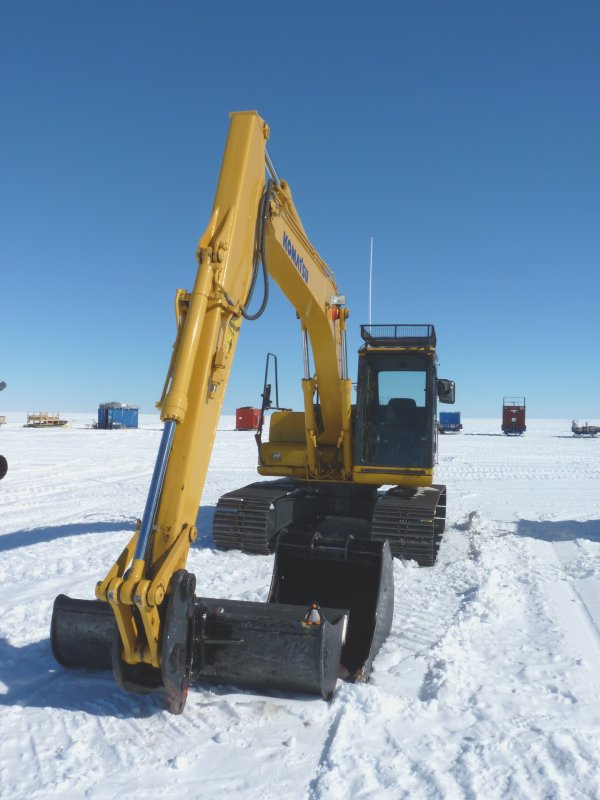
Although the Nodwells are far smaller cranes, they are far better at moving around on the snow. The other vehicle we have is the excavator, this is great for digging snow but the bucket can also be used for lifting small loads for which it is very quick.
How many times did you see Penny?
![]() |
| John Deere Tractor |
These have a special adaptation for Antarctica, with a Soucy track in place of each wheel. The John Deeres are very versatile, they can tow nearly as much as a Challenger, they can work in temperatures nearly as cold as a dozer, and they also can lift loads with their front forks.
Because we have so many loads to lift associated with the build of Halley VI and the demolition of Halley V, for the duration of the project we also have a JCB forklift, also with a track conversion.
| JCB forklift |
The JCB will be sent out at the end of the build/demolition, probably next year. Our biggest crane the Mantis will also be sent out at the same time.
| Mantis Crane |
The Mantis is our heaviest vehicle on the iceshelf - it weighs 24 tonnes and can lift 30 tonne loads. Once the Mantis has been sent out, we will still have two Nodwell cranes, capable of 5 tonne lifts.
![]() |
| Nodwell Crane |
How many times did you see Penny?
Wednesday, 18 January 2012
Big vehicles at Halley - part 1
In the previous post I showed the mobile elevated work platform, or cherry picker as its usually known. Halley always has lots of big vehicles, they are needed for lots of tasks like moving cargo from the coast to the station and pushing snow around the station. At the moment we have some extra vehicles to help build the new station and to demolish the old. So here is rundown of what we have. We have two Cat Challengers, they are our most powerful machines with 325HP 9L turbo diesel engines. They can tow 40 tonne loads and are fast, without a load they can reach 40km/hr. Unfortunately they are thirsty and can burn a 1L of fuel per minute! Like all our diesel engines here we run them on aviation diesel (called Avtur) which does not freeze or wax.
The problem with the Challenges is that they can only really do one thing, that is tow heavy loads long distances in summer. The vehicle of choice in winter is a D5 dozer, metal tracks, engine heaters and simple engine management means it will work no matter how cold. It's very heavy at about 14 tonnes so it can pull heavy loads, but its very slow with a maximum speed of about 8km/hr. We have two dozers.
The dozer can only really seat one person and it is too heavy for towing loads on seaice. Snowcats are lighter (our lightest being just 5 tonnes) and can carry people - our biggest seating 9 in comfort. Some snowcats have their engines at the back, like this one which is used to groom snow to make it smooth.
While some snowcats have the engines in the front. This one is towing a load on the seaice, the driver leaves the door open in case it breaks through the seaice (which doesn't happen very often!). In total we have eight snowcats.
Did you see Penny?
| Cat Challenger |
![]() |
| A D5 Dozer |
While some snowcats have the engines in the front. This one is towing a load on the seaice, the driver leaves the door open in case it breaks through the seaice (which doesn't happen very often!). In total we have eight snowcats.
Did you see Penny?
Saturday, 14 January 2012
Cherry Picking
Mobile elevated work platforms, or cherry pickers as they are known, are very useful pieces of kit and extensively used at Halley for accessing high objects. One job we had this season was to cable up one of the large radars known as Superdarn. It measures the position and velocity
of charged particles in the Earth's ionosphere, the highest layer of the Earth's
atmosphere. Because the movements of these particles are tied to the movements of
the Earth's magnetic field which, in turn, extends into space, Superdarn
provides scientists with information regarding the Earth's interaction with the
space environment. The radar itself has 16 large antennas mounted on high towers, here is the cherry picker reaching up to one.
And here is Penny trying hard not to fall off one of the antennas while I work cabling up.
Wednesday, 11 January 2012
Small Vehicles at Halley
We have a large number of small vehicles at Halley. Mostly snow mobiles, more commonly known as skidoos. This is me riding an AlpineII skidoo between Halley V and Halley VI, we tend to ride around station without crash helmets but on journeys off station we wear crash helmets.
The sledge I am towing is colloquially known as the Pope Mobile, and very comfortable it is too. The Alpine II is quite pokey, 500cc engine. We have several differnt types of skidoo, the very comfortable Tundra (smaller 250cc engine).
And the fast Scandic, best of both worlds 500cc engine, double ski, single narrow track.
We also have a whole host of different sledges that we tow behind the skidoo, some for cargo and some for people - like the thing we call the happy sledge, which can take 8 people.
We also have a couple of tracked 4x4's, here are Sam and Neil having fun on one. They aren't as easy to maintain or use as a skidoo, are slower too, but they can haul bigger loads.
Did you see Penny?
The sledge I am towing is colloquially known as the Pope Mobile, and very comfortable it is too. The Alpine II is quite pokey, 500cc engine. We have several differnt types of skidoo, the very comfortable Tundra (smaller 250cc engine).
And the fast Scandic, best of both worlds 500cc engine, double ski, single narrow track.
We also have a whole host of different sledges that we tow behind the skidoo, some for cargo and some for people - like the thing we call the happy sledge, which can take 8 people.
We also have a couple of tracked 4x4's, here are Sam and Neil having fun on one. They aren't as easy to maintain or use as a skidoo, are slower too, but they can haul bigger loads.
Did you see Penny?
Saturday, 7 January 2012
Planting trees
Halley VI is being completed, in the meantime most of the station facilities and power aren't yet available so the science team is concentrating on outside work. One of the tasks is to build an array of antennas for one of the scientific radars called the MFradar. To start with we had to survey the position of each of the antenna, for this we had to perform a sunshot to get true north so we could then use compasses and theodolites to mark the position of each antenna and its support pole. Here is Julius surveying.
Once we had flags marking the intended positions, we drilled holes using a ice drill.
And then lifted in the poles using a crane.
In total we planted 25 poles, here are some of them:
Once we had flags marking the intended positions, we drilled holes using a ice drill.
And then lifted in the poles using a crane.
In total we planted 25 poles, here are some of them:
Friday, 6 January 2012
Tower Raising
This is our Clean area lab - known as CASLAB, it is used for air chemistry and for air to ice energy transfer studies. The whole area around it is kept very clean; normally no vehicles come within 1km of it and even then only in the direction that the wind doesn't blow from. About once every couple of years we have to use a crane to get new legs onto the CASLAB but we try very hard to do everything in the clean area without vehicles.
There is a tall tower next to the CASLAB, 31.5m high, which
will have lots of scientific instruments placed upon it. Like all things at
Halley, the snow accumulation reduces its height by about 1m or so a year and
it needs raising to keep the instruments at the correct height.
This tower has a clever way of extending that doesn't need
any vehicles. A frame is wrapped around the tower.
The tower sections are then unbolted from each other and the
tower winched up in the frame.
Then a new section is bolted in the gap.
The frame is removed, and volia the Tower is now 1.5m higher at 33m.
Here is the team - me, I am the one in the orange boiler suit and orange
helmet.
Wednesday, 4 January 2012
Cats on Contrast.
Today I needed to drive the 16km from Halley VI back to Halley V in a snow cat. First thing in the morning was slightly foggy but with the sun nearly burning through - horizontal contrast poor, surface contrast good. This is the view from the snowcat, you can see clearly see the first drum of the drum line that I was following but the next drum and the horizon are very faint. The tracks of other vehicles that have driven the route are clearly visible.
Ok, I'll stop going on about contrast.
Tuesday, 3 January 2012
Back to school
Back to school - but not for me! Wishing all the children and teachers who go back to school this week the best of luck - especially those in Willingham.
This photo was taken in front of the big red living module of Halley VI. More on Halley VI in later posts.....
Monday, 2 January 2012
Antarctic Pixies
Halley is a remarkably sunny place - it actually gets more hours of sunshine than the UK, and of course most photographs tend to get taken on sunny days. When its cloudy or snowing then it gives a chance for the Antarctic Pixies to come out and play
Someone asked about how pilots can judge the ground, the answer is they need both horizontal and surface contrast. In the photo above you can't see the horizon which we call no horizontal contrast, you also can't see any details in the snow surface, so that's no surface contrast. When there is no horizontal or surface contrast you don't want to be landing planes! In fact even walking around can be tricky as you can trip over piles of snow without seeing them at all.
The photo below is still poor surface contrast (which is better than nil), but now has good horizontal contrast. The pilots land planes in those sort of conditions but only at sites they know are crevasse and sastrugi free. Sastrugi are irregularities in the surface of the snow caused by the wind.
Saturday, 31 December 2011
What a relief
Our ship, the Ernest Shackleton, arrived on Boxing day; bring with it all the cargo, food and fuel for the year, and some more staff too. The ship moors up in a creek against the seaice from where the cargo can be dragged up on the iceshelf.
Below is a stock BAS photo that gives a better idea of the creeks.
When I first came to Halley many years ago, relief involved much manual handling and manpower but now big machines do all the hardwork. The cargo is craned onto a sledge at one end, pulled by CAT Challengers or John Deere tractors to the other where it is unloaded by crane. It is about 30km from the coast to the Halley VI site. Here is a CAT Challenger pulling 3 fully loaded containers.
The cargo is laid out in a long line at the Halley VI site so that each dept can find their boxes.
One item off the ship that is eagerly anticipated is fresh fruit and vegetables. Its only been 4 weeks since my last fresh fruit but that first Orange tasted really good, for the winterers (that's the people that are on a 15 month tour) this will be their first fresh fruit for nearly 10 months.
Below is a stock BAS photo that gives a better idea of the creeks.
When I first came to Halley many years ago, relief involved much manual handling and manpower but now big machines do all the hardwork. The cargo is craned onto a sledge at one end, pulled by CAT Challengers or John Deere tractors to the other where it is unloaded by crane. It is about 30km from the coast to the Halley VI site. Here is a CAT Challenger pulling 3 fully loaded containers.
The cargo is laid out in a long line at the Halley VI site so that each dept can find their boxes.
One item off the ship that is eagerly anticipated is fresh fruit and vegetables. Its only been 4 weeks since my last fresh fruit but that first Orange tasted really good, for the winterers (that's the people that are on a 15 month tour) this will be their first fresh fruit for nearly 10 months.
Thursday, 29 December 2011
Landing in a Twin Otter
Here is a short video of the landing we did at the field site - its actually a lot smoother than it looks but its hard to old a camera steady as you plonk down. You will notice that we are landing on to tracks, the procedure is that the pilot 'trails skis' - that is makes a landing but doesn't slow down and takes off again. The pilot can then check that no crevasses have opened up on the tracks before doing the landing proper.
Subscribe to:
Posts (Atom)