One major difference between the Arctic and the Antarctic is that of Polar Bears - the ultimate top predator. All researchers here are trained in the polar bear hazard and one or two people in the party are given extra training in weapons, a flare pistol to try and scare the bear away and if the worst should come to the worst, a rifle to shoot the bear. Here am I getting rifle familiarisation.
At the rifle range you get plenty of opportunity to practice. It't about 30m to the target, a distance a bear can cover in less than 3s. I am the one on the right, both Geoff and I managed to hit the target on all our shots - that's the black dot.
Most of the training is about safety, unless you are very methodical and careful then the guns could be a worse hazard than the bears! However, I passed and am now certificated.
Here's my skidoo in front of the NERC building here ay Ny-Alesund. Flare pistol on the front:
And rifle holder on the rear:
Generally, this exposure to guns and carrying round a rifle each day has just reinforced my view of guns, they are very violent, dangerous things which should not be allowed to fall into the wrong hands. Much as I would love to see a polar bear I very much hope that I don't have to even try and frighten one away let alone shoot it.
Thursday, 22 March 2018
Wednesday, 21 March 2018
Flight to Ny-Alesund
Flight across to Ny-Alesund is a short 30min hop in a Dornier (228 I think).
There is lots of scenery for such a short flight.
Arrival at Terminal 1 Ny-Alesund
There is lots of scenery for such a short flight.
Arrival at Terminal 1 Ny-Alesund
Tuesday, 20 March 2018
Arrival in Longyearbyen
A normal comfortable passenger plane ride from Oslo to Longyearbyen, although it's a cold walk down the steps here.
And in the arrivals hall if you were in any doubt about where you were...
Thursday, 15 March 2018
Crank her up.
Haven't posted here for a while but I am just about to go on another trip. This time, a short one to Ny Alesund in Svalbard. I am going with a team from Manchester University to test and characterise the equipment that we are planning to use to find Iron Meteorites in Antarctica.
Nice news story about it here:
http://www.bbc.co.uk/news/science-environment-35587680
Nice news story about it here:
http://www.bbc.co.uk/news/science-environment-35587680
Monday, 25 February 2013
Back in the UK
Arrived back in the UK at Sat lunch time after leaving Halley on Thursday morning. Quite astonishing that you can get so quickly from Halley to the UK. The journey was the opposite of the one I took in Nov 2011, From Halley to Novo, about 900km and 4 hours in a Basler DC3.
We had some excellent views of the spectacular mountains on the journey, I'll post some later.
At Novo we got straight on to the Ilyshian76 for a 5 hour 4000km journey to Capetown, 24 hours of enjoying the warmth and sunshine before flying back to grotty and cold Heathrow.
At just 4 weeks (and four continents) one of my shorter trips to Antarctica.
We had some excellent views of the spectacular mountains on the journey, I'll post some later.
At Novo we got straight on to the Ilyshian76 for a 5 hour 4000km journey to Capetown, 24 hours of enjoying the warmth and sunshine before flying back to grotty and cold Heathrow.
At just 4 weeks (and four continents) one of my shorter trips to Antarctica.
Wednesday, 20 February 2013
Quick post before leaving.
I should be leaving early for Novo tomorrow morning. I'll be out of internet for a few days, perhaps until I am back in the UK. here are a couple of random photos from around Halley VI.
This is my shadow off the bridge late one evening. The bridge separates the two halves of the station, each of which have generators; so the bridge means that even if there was a serious fire we would still retain living space and a working set of generators.

The next picture is of the phone booth in the summer accommodation module - I like it!

End post
This is my shadow off the bridge late one evening. The bridge separates the two halves of the station, each of which have generators; so the bridge means that even if there was a serious fire we would still retain living space and a working set of generators.
The next picture is of the phone booth in the summer accommodation module - I like it!
End post
Halley VI - inside science modules.
The two modules at the south end of the station are the science modules. I posted some pictures last year taken in the science modules, here are some more. This is one of the project labs.

This is the wet chemistry lab.

Here is our science store room from two angles:


At the very end of the station, is the fieldprep room.

And upstairs is the meteorological observation room.

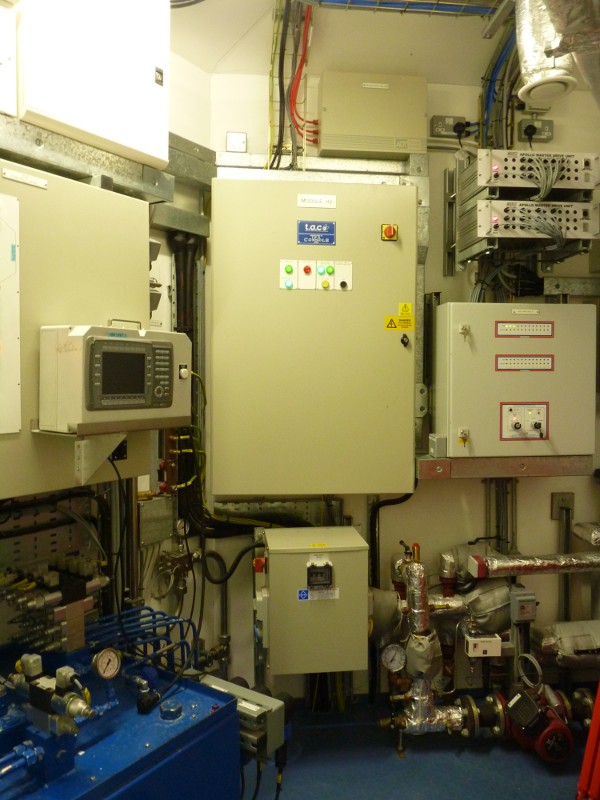
Every module has its own plant room that controls the hydraulic legs and the heat and vent for that module.

End post.
This is the wet chemistry lab.
Here is our science store room from two angles:
At the very end of the station, is the fieldprep room.
And upstairs is the meteorological observation room.
Every module has its own plant room that controls the hydraulic legs and the heat and vent for that module.
End post.
Tuesday, 19 February 2013
More inside Halley VI
Sunday, 17 February 2013
Halley VI Gym
Halley VI has a great gym, maybe a bit too full of equipment.

Its upstairs in big red module. Here is the view in the opposite direction.

And here is the view from the running machine, looking south over the air intakes and generator exhausts of one of the energy modules.

However, if the weather is reasonable I much prefer to run or ski outside.
Its upstairs in big red module. Here is the view in the opposite direction.
And here is the view from the running machine, looking south over the air intakes and generator exhausts of one of the energy modules.
However, if the weather is reasonable I much prefer to run or ski outside.
Saturday, 16 February 2013
Bedrooms at Halley VI
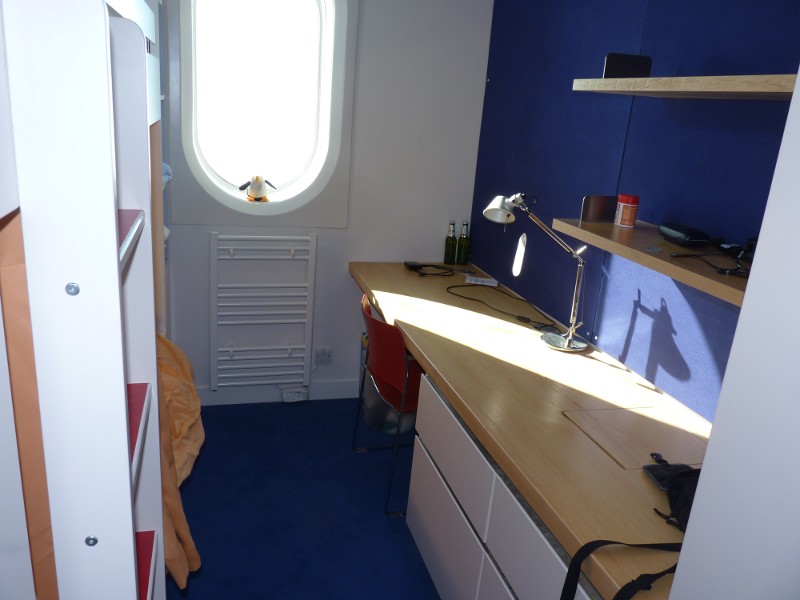
The bedrooms at HalleyVI are small but really comfortable. In winter people get a room to themselves but in summer there is someone in each bunk. They have lots of storage space and nooks and crannies. They are quite hard to get a good photo of because they are quite small, but it gave Peter penguin several opportunities to get in the picture!


The beds are really long which I find great. The Phillips lights are nice - they act as alarm clocks and they also have daylight bulbs in them to help the winterers avoid seasonal adjustment disorder.
Friday, 15 February 2013
The Maggy Tunnel
Here's a bit of Halley that most people (even those who come here) never see. It's the magnetometer shaft. On the outside it looks like a big wooden box on the snow:

But inside it leads to a tunnel about 7m under the snow (and getting deeper) that contains a very sensitive magnetometer.

And the small lab where the computers for the magnetometers are:

The magnetometers are very sensitive and need to be thermally and physically stable which is why they are in a tunnel down in the snow. They are used to measure electrical currents flowing in the ionosphere which tells scientists about the way that solar wind connects to the earths atmosphere.

But inside it leads to a tunnel about 7m under the snow (and getting deeper) that contains a very sensitive magnetometer.

And the small lab where the computers for the magnetometers are:
The magnetometers are very sensitive and need to be thermally and physically stable which is why they are in a tunnel down in the snow. They are used to measure electrical currents flowing in the ionosphere which tells scientists about the way that solar wind connects to the earths atmosphere.
Thursday, 14 February 2013
What a lovely evening
Yesterday was blowing about 25 knots, cold and drifting snow, however today the weather just got better and better and ended with a lovely still and sunny evening. I went for a ski around the station perimeter. I put photos in my blog last year of me skiing so rather than repeat them, here is a photo of my shadow while skiing.

I know some ex-Halley fids (people who come south are known as colloquially as fids, after the name Falkland Island Dependencies Survey which was a very early name for BAS) read my blog. One thing that has changed in recent years is that we now groom the snow a lot more. The groomer was initially purchased for grooming the runway for larger planes like the Basler DC3. However the groomer has turned out to be very useful, the whole station is regularly groomed in the summer which makes it easier to walk around and less harsh on vehicles. One benefit of this is that the perimeter occasionally gets groomed. Here it is tonight, a lovely smooth track, still soft but tomorrow it will make a lovely running surface once it hardens up.

The tent is for people who would normally not get a chance to sleep in an Antarctic tent because their jobs are on station. Although I don't expect to sleep in a tent this season I have done so many times in the past.
I know some ex-Halley fids (people who come south are known as colloquially as fids, after the name Falkland Island Dependencies Survey which was a very early name for BAS) read my blog. One thing that has changed in recent years is that we now groom the snow a lot more. The groomer was initially purchased for grooming the runway for larger planes like the Basler DC3. However the groomer has turned out to be very useful, the whole station is regularly groomed in the summer which makes it easier to walk around and less harsh on vehicles. One benefit of this is that the perimeter occasionally gets groomed. Here it is tonight, a lovely smooth track, still soft but tomorrow it will make a lovely running surface once it hardens up.
The tent is for people who would normally not get a chance to sleep in an Antarctic tent because their jobs are on station. Although I don't expect to sleep in a tent this season I have done so many times in the past.
Wednesday, 13 February 2013
Halley VI in winter colours
Its getting distinctly murky at night and in a week or or so, when I leave there will be the first of the sunsets. But I will never see Halley VI in its winter colours. One of last year's winterers, Sam Burrell, has kindly given me some of his pictures from the depth of winter. Here is a great one of the Aurora over the station.

And another showing the modules in the dark.

But here is my favorite one of Sam's pictures.

End of post

And another showing the modules in the dark.

But here is my favorite one of Sam's pictures.

End of post
Tuesday, 12 February 2013
Halley Again
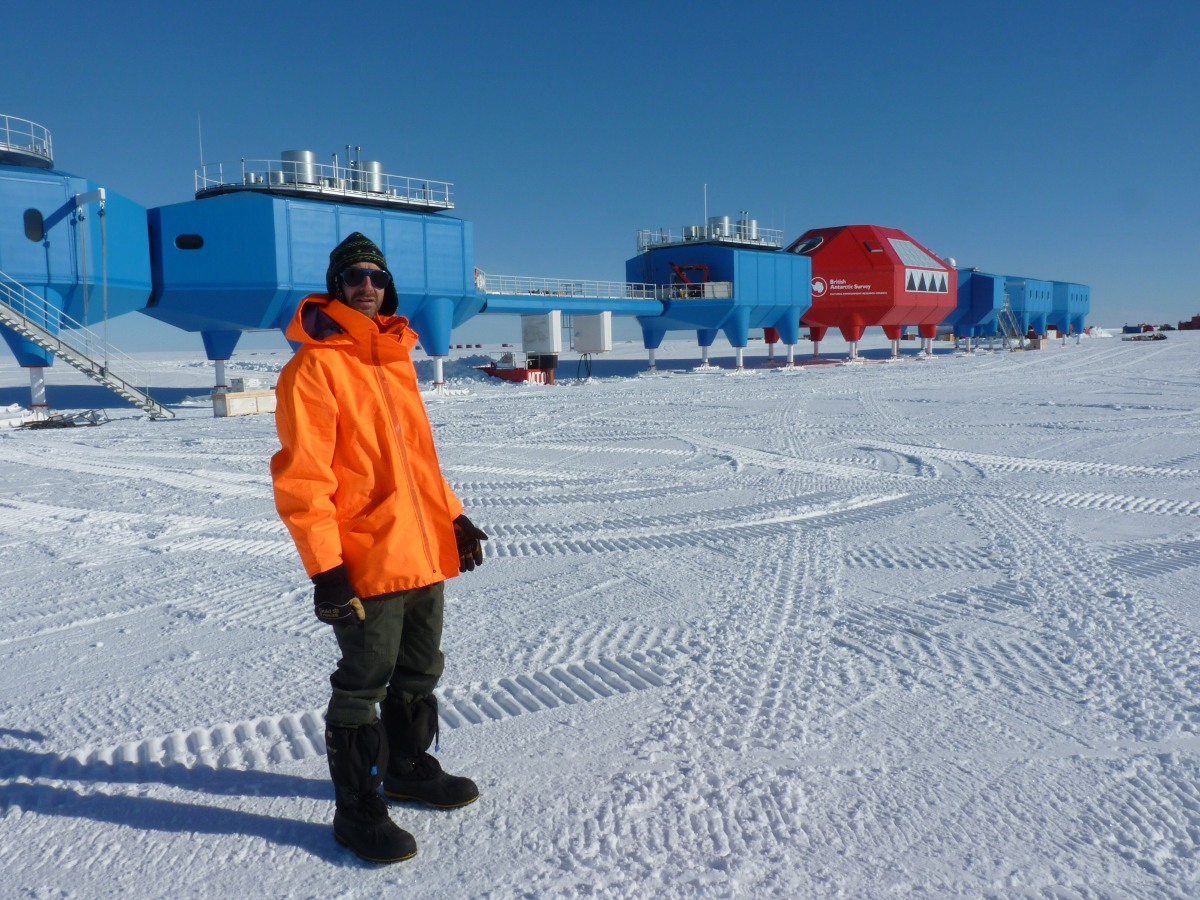
Halley VI is jacked up and prepared for its winter ahead.

In fact these photos were taken almost exactly a year ago. Both the station and I look pretty much the same - I still have the same hat! The one above is taken of the East side of the station, with the camera facing NW.
The one below is of the North end of the station with the camera facing South.

end post
In fact these photos were taken almost exactly a year ago. Both the station and I look pretty much the same - I still have the same hat! The one above is taken of the East side of the station, with the camera facing NW.
The one below is of the North end of the station with the camera facing South.
end post
Monday, 11 February 2013
Flight from Rothera part 2.
Lack of views on the way over meant I took the opportunity to take some photos inside the plane. Here is Peter Penguin and yours truly in the cockpit.

And for those of you who like dials and switches, here are the controls:

The reason the Twin Otter can fly for so far with a reasonable payload is that we have an extend range fuel tank in the back.

And here I am in the back of the plane.

End post
And for those of you who like dials and switches, here are the controls:
The reason the Twin Otter can fly for so far with a reasonable payload is that we have an extend range fuel tank in the back.
And here I am in the back of the plane.
End post
Sunday, 10 February 2013
Flight from Rothera - part 1
Here is the route from Rothera to Halley.

The distance that the Twin Otter aircraft can fly depends upon how much stuff we put inside it. We had minimal cargo, and just two of us passengers and the pilot Adam which gives about a 6 hours endurance. Unfortunately it takes longer than this to fly to Halley so we had to refuel somewhere. The primary target to refuel was Fossil Bluff, two hours flying south of Rothera. All of the fuel at Fossil Bluff has previously been flown there which means it is expensive, but cheaper than the fuel at Sky Blu which is yet another hour further south. Although the weather wasn't great, and the views overall were disappointing, there was break in the clouds which gave us some views and also allowed us into Fossil Bluff to refuel.

From Fossil Bluff it was just a little over 5 hours over to Halley. Total distance Rothera to Halley, 1800km.

The distance that the Twin Otter aircraft can fly depends upon how much stuff we put inside it. We had minimal cargo, and just two of us passengers and the pilot Adam which gives about a 6 hours endurance. Unfortunately it takes longer than this to fly to Halley so we had to refuel somewhere. The primary target to refuel was Fossil Bluff, two hours flying south of Rothera. All of the fuel at Fossil Bluff has previously been flown there which means it is expensive, but cheaper than the fuel at Sky Blu which is yet another hour further south. Although the weather wasn't great, and the views overall were disappointing, there was break in the clouds which gave us some views and also allowed us into Fossil Bluff to refuel.
From Fossil Bluff it was just a little over 5 hours over to Halley. Total distance Rothera to Halley, 1800km.
Subscribe to:
Posts (Atom)